Analisis Baseflow DAS Setail Menggunakan Metode Grafis (Baseflow Analysis of Setail Watershed Using Graphical Method)
DOI:
https://doi.org/10.59465/jppdas.2025.9.2.145-164Keywords:
Baseflow, Setail, Graphical, HYSEP, WatershedAbstract
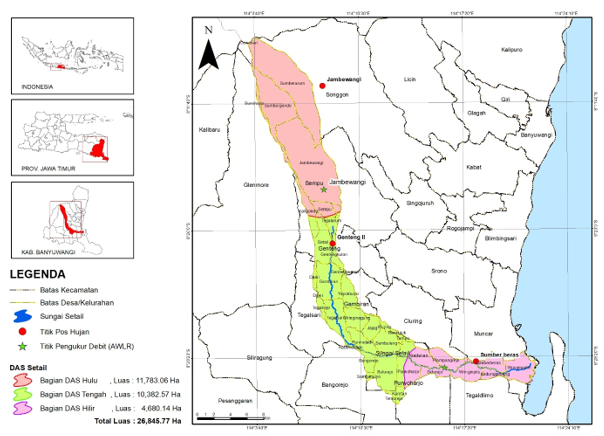
Baseflow separation methods are widely applied in hydrological studies; however, they are rarely implementated in small- to medium-scale catchments in tropical monsoonal climates. Understanding baseflow dynamics in this area is essential for sustainable watershed management, especially under increasing hydrometeorological stress. This study evaluates the performance of three graphical HYSEP algorithms (Fixed Interval, Sliding Interval, and Local Minimum) applied to the Setail Watershed in Banyuwangi Regency, Indonesia. This area experiences recurrent downstream flooding and seasonal drought. Daily streamflow data from Automatic Water Level Recorders (AWLR) in Jambewangi (upstream) and Kradenan (downstream) were used as input. Calibration was performed using a trial-and-error approach in the BFI+ software to obtain the optimal parameters that best fit the observed and estimated baseflow. Model performance was assessed using coefficient of determination (R²), Root Mean Square Error (RMSE), and Flow Duration Curve (FDC) analysis. The Local Minimum algorithm demonstrated the highest R² value (up to 0.98) and the lowest RMSE (0.38) during both the calibration and validation periods, performing best overall. A high Baseflow Index (BFI) indicates that baseflow significantly contributes to total streamflow. This reflects the permeable characteristics of the watershed and its capacity to maintain discharge during the dry seasons. These findings confirm the applicability of the HYSEP method for tropical watersheds and emphasize the importance of local-scale calibration to improve model reliability and support adaptive water resource management under monsoonal climate variability.
Downloads
Published
How to Cite
Issue
Section
License
Copyright (c) 2025 Jurnal Penelitian Pengelolaan Daerah Aliran Sungai (Journal of Watershed Management Research)

This work is licensed under a Creative Commons Attribution-NonCommercial-ShareAlike 4.0 International License.