
PRODUCTIVITY AND ECONOMIC IMPACT OF BAMBOO IN MONOCULTURE VERSUS MIXED SYSTEMS: IMPLICATIONS FOR SOCIAL FORESTRY
DOI:
https://doi.org/10.59465/ijfr.2026.13.1.53-76Keywords:
bamboo, economic contribution, monoculture, agroforestry, production, village forestAbstract
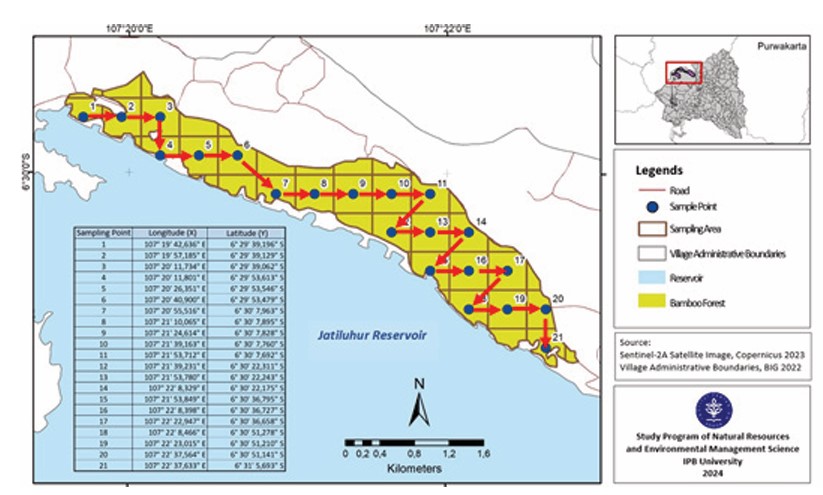
Bamboo forests serve as valuable assets which assist in developing social forestry programs that benefit local communities. The research investigates how bamboo grows and its economic value through two different planting methods which include monoculture and mixed systems at a Indonesian village forest. Researchers used systematic sampling methods to collect data from 21 plots which included 14 monoculture plots 6 mixed-system plots and 1 shrub plot. The research team focused on gathering data about clump characteristics and culm density and regeneration proportion. The researchers used the Mann–Whitney U test to analyze system differences because the data did not follow normal distribution. The study results show that monoculture bamboo systems produce higher output levels and generate greater financial benefits than mixed systems. The monoculture stands achieved an annual output of 6,374 culms per hectare which results in an estimated economic value of IDR 50,992,000 per hectare every year. The mixed systems produced 5,242 culms per hectare each year whereas the system generated an output of 5,242 culms. The study found that monoculture systems produced more young bamboo regeneration which reached 30.8% compared to mixed systems which generated 27.0% of young bamboo regeneration showing that monoculture systems have better regenerative capabilities.
Downloads
References
[EBF] Environmental Bamboo Foundation - Australian Center for International Agricultural Research (2023). Small research and development activity - Bamboo agroforestry in East Nusa Tenggara Environmental. https://www.aciar.gov.au/sites/default/files/2023-01/FST-2021-161-final-report.pdf?utm_source=chatgpt.c om
[ITTO] International Tropical Timber Organization (2025). Developing the bamboo industry in Indonesia. https://www.itto.int/sdg-details/developing_the_bamboo_industry_in_Indonesia.
[OID] Officer of Information and Documentation of the Ministry of Environment and Forestry, Republic of Indonesia (2016). 12.7 ha kawasan hutan untuk kegiatan Perhutanan Sosial. Berita Tapak Kementerian Lingkungan Hidup Dan Kehutanan. http://ppid.menlhk.go.id/berita/berita-tapak/2855/127-ha-kawasan-hutan-untuk-kegiatan-perhutanan-sosial
Akoto, D. S., Partey, S. T., Denich, M., Kwaku, M., Borgemeister, C., & Schmitt, C. B. (2020). Towards bamboo agroforestry development in Ghana: evaluation of crop performance, soil properties and economic benefit. Agroforestry Systems, 94(5), 1759–1780. https://doi.org/10.1007/s10457-020-00493-7
Angessa, A. T., Lemma, B., & Yeshitela, K. (2021). Land-use and land-cover dynamics and their drivers in the central highlands of Ethiopia with special reference to the Lake Wanchi watershed. GeoJournal, 86(3), 1225–1243. https://doi.org/10.1007/s10708-019-10130-1
Ayer, S., Timilsina, S., Aryal, A., Acharya, A. K., Neupane, A., & Bhatta, K. P. (2023). Bamboo forests in Nepal_ Status, distribution, research trends and contribution to local livelihoods. Advances in Bamboo Science, 4(June), 100027. https://doi.org/10.1016/j.bamboo.2023.100027
Ballullaya, U. P., Reshmi, K. S., Rajesh, T. P., Manoj, K., Lowman, M., & Allesh Sinu, P. (2019). Stakeholder motivation for the conservation of sacred groves in south India: An analysis of environmental perceptions of rural and urban neighbourhood communities. Land Use Policy, 89. https://doi.org/10.1016/j.landusepol. 2019.104213
Banjade, M. R., Herawati, T., Liswanti, N., & Mwangi, E. (2017). Reformasi tenurial hutan di Indonesia: Kapan? Apa? Mengapa? - Reformasi tenurial hutan di Indonesia: Kapan? Apa? Mengapa? Center for International Forestry Research (CIFOR). https://doi.org/10.17528/cifor/006557
Basani, C. S. (2018). Perlindungan dan pengelolaan keanekaragaman hayati Indonesia oleh pemerintah dan masyarakat. Bina Hukum Lingkungan, 3(1), 94–103. http://mail.bhl-jurnal.or.id/index.php/bhl/article/ view/bhl.v3n1.7
Belete, T., & Yadete, E. (2023). Effect of mono cropping on soil health and fertility management for sustainable agriculture practices: A review. Journal of Plant Sciences, 11(6), 192–197. https://doi.org/10.11648/j.jps. 20231106.13
Boissière, M., Atmadja, S., Benmakhlouf, S., Beyessa, M., Kassa, H., Hunde, T., & Assefa, F. (2020). Developing small-scale bamboo enterprises for livelihoods and environmental restoration in Benishangul-Gumuz Regional State, Ethiopia. International Forestry Review, 22(3), 306–322. https://doi.org/10.1505/ 146554820830405618
Bonilla, D. A. G. (2021). Identification and analysis of the characteristics of voluntary sustainability standards in the international market of agro-industrial goods. Proceedings of the International Conference on Industrial Engineering and Operations Management, 93–94. https://www.scopus.com/inward/record.uri?eid=2-s2.0-85121145778&partnerID=40&md5=3688ba0d9dfc4614bd025b15cbc38af0
Buchari, R. A., Darmawan, I., Utami, S. B., Achmawati, N. J., Novel, Qisty, J., Sandjaya, T., & Susetyaningsih, A. (2023). Pemanfaatan teknologi dalam percepatan peran desa untuk mencapai SDGs Desa Tanpa Kemiskinan di Desa Mekarsari, Kecamatan Selaawi, Kabupaten Garut. Kumawula : Jurnal Pengabdian Kepada Masyarakat, 6(2), 292–297.
Chen, X., & Bai, S. (2023). Effects of Moso Bamboo Expansion on the Spatial Pattern of Coarse Woody Debris in Secondary Coniferous and Broad-Leaved Mixed Forest in Wuxie National Forest Park, China. Forests, 14(7). https://doi.org/10.3390/f14071402
Condro, A. A., Prasetyo, L. B., Rushayati, S. B., Santikayasa, I. P., & Iskandar, E. (2022). Protected areas slow down tropical rainforest disturbance in the Leuser Ecosystem, Indonesia. Journal of Land Use Science, 17(1), 454–470. https://doi.org/10.1080/1747423X.2022.2115571
Dransfield, S., & Widjaja, E. A. (1995). Bamboos. In Plant Resources of South-East Asia. Leiden: Backhuys Publishers. https://doi.org/10.1177/002205749005100810
Ekanayake, E. M. B. P., Xie, Y., & Ahmad, S. (2021). Rural residents' participation intention in community forestry-challenge and prospect of community forestry in Sri Lanka. Forests, 12(8), 1–16. https://doi. org/10.3390/f12081050
Fiqri, M. U. (2023). Kelembagaan petani perhutanan sosial di LMDH Bambu Jaya KPH Purwakarta [IPB University]. In IPB University. https://repositorio.ufsc.br/xmlui/bitstream/handle/123456789/167638/ 341506.pdf?sequence=1&isAllowed=y%0Ahttps://repositorio.ufsm.br/bitstream/handle/1/8314/LOEBLEIN%2C LUCINEIA CARLA.pdf?sequence=1&isAllowed=y%0Ahttps://antigo.mdr.gov.br/saneamento/ proees
Fisher, M. R., Dhiaulhaq, A., & Sahide, M. A. K. (2019). The politics, economies, and ecologies of Indonesia's third generation of social forestry: An introduction to the special section. Forest and Society, 3(1), 152–170. https://doi.org/10.24259/fs.v3i1.6348
Gunawan, H., & Afriyanti, D. (2019). Potensi perhutanan sosial dalam meningkatkan partisipasi masyarakat dalam restorasi gambut. Jurnal Ilmu Kehutanan, 13(2), 227. https://doi.org/10.22146/jik.52442
Hani, A., Suryanto, P., Murniati, & Widiyatno. (2024). Growth of Betung Bamboo (Dendrocalamus asper) and Food Crop Production Under Agroforestry Bamboo Systems. Jurnal Manajemen Hutan Tropika, 30(1), 155–168. https://doi.org/10.7226/jtfm.30.1.155
Hocking, D., Hocking, A., & Ray, I. (1997). Trees in Bangladesh paddy fields and homesteads: The future of forestry in crowded countries. Commonwealth Forestry Review, 76(4), 255–260. https://www.scopus.com/ inward/record.uri?eid=2-s2.0-3743068340&partnerID=40&md5=128091c79874edd884387a8165c929d6
Ihsan, M., Irawan, B., Iskandar, B. S., & Iskandar, J. (2023). Ethnobotanical study on using bamboo for kites making in Sumedang District, West Java, Indonesia. Biodiversitas, 24(4), 2393–2401. https://doi.org/10. 13057/biodiv/d240454
Isukuru, E. J., Ogunkeyede, A. O., Adebayo, A. A., & Uruejoma, M. F. (2023). Potentials of bamboo and its ecological benefits in Nigeria. Advances in Bamboo Science, 4(May), 100032. https://doi.org/10.1016/j. bamboo.2023.100032
Kaskoyo, H., Febryano, I. G., & Banuwa, I. S. (2019). Pengelolaan Hutan Rakyat di Kabupaten Tulang Bawang Barat. Jurnal Sylva Lestari, 7(1), 42–51. https://doi.org/10.23960/jsl1742-51
Kiss, B., Sekulova, F., Hörschelmann, K., Salk, C. F., Takahashi, W., & Wamsler, C. (2022). Citizen participation in the governance of nature-based solutions. Environmental Policy and Governance, 32(3), 247–272. https://doi.org/10.1002/eet.1987
Klepacka, A. M., Florkowski, W. J., & Revoredo-Giha, C. (2017). Farmers and their groves: Will cost inefficiency lead to land use change? Land Use Policy, 61, 329–338. https://doi.org/10.1016/j.landusepol.2016.11.032
Kumar, R. S., Binu, N., Nishant, N., Buxy, S., & Sinha, G. (2014). A review of bamboo based agroforestry models developed in different parts of India, productivity and marketing aspects. Bamboo Productivity in Forest and Non – Forest Areas, January, 45–52. http://14.139.185.57:8080/jspui/bitstream/123456789/10785/1/A REVIEW OF BAMBOO BASED AGROFORESTRY MODELS DEVELOPED IN DIFFERENT PARTS OF INDIA%2CPRODUCTIVITY AND MARKETING ASPECTS.pdf
Kusumadewi, S. D., Purnomo, H., Okarda, B., Azzahra, M., Iswadi, A. M., Puspitaloka, D., Nadhira, S., Irawan, P., & Liswanti, N. (2024). Simulating jurisdictional approach and scenario for sustainable palm oil using value chain dynamic model. IOP Conference Series: Earth and Environmental Science, 1379(1). https://doi.org/10.1088/1755-1315/1379/1/012020
Kusumoarto, A., Gunawan, A., & Nurazizah, G. R. (2017). Landscape Potential Analysis for Ecotourism Destination in the Resort II Salak Mountain, Halimun-Salak National Park. IOP Conference Series: Earth and Environmental Science, 91(1). https://doi.org/10.1088/1755-1315/91/1/012029
Laudari, H. K., Sapkota, L. M., Maraseni, T., Subedi, P., Pariyar, S., Kaini, T. R., Lopchan, S. B., Weston, C., & Volkova, L. (2024). Community forestry in a changing context: A perspective from Nepal's mid-hill. Land Use Policy, 138(December 2021), 107018. https://doi.org/10.1016/j.landusepol.2023.107018
Lehmann, L. M., Smith, J., Westaway, S., Pisanelli, A., Russo, G., Borek, R., Sandor, M., Gliga, A., Smith, L., & Ghaley, B. B. (2020). Productivity and economic evaluation of agroforestry systems for sustainable production of food and non-food products. Sustainability (Switzerland), 12(13), 1–9. https://doi.org/10.3390/ su12135429
Liu, C. L. C., Kuchma, O., & Krutovsky, K. V. (2018). Mixed-species versus monocultures in plantation forestry: Development, benefits, ecosystem services and perspectives for the future. Global Ecology and Conservation, 15(July), e00419. https://doi.org/10.1016/j.gecco.2018.e00419
Lobovikov, M., Schoene, D., & Yping, L. (2012). Bamboo in climate change and rural livelihoods. Mitigation and Adaptation Strategies for Global Change, 17(3), 261–276. https://doi.org/10.1007/s11027-011-9324-8
López-Carr, D. (2021). A review of small farmer land use and deforestation in tropical forest frontiers: Implications for conservation and sustainable livelihoods. Land, 10(11). https://doi.org/10.3390/land10111113
Lugt, P. Van Der, & King, C. (2019). Bamboo in the circular economy. INBAR Working Paper, Policy Syn(6), 36. https://www.inbar.int/wp-content/uploads/2019/12/Bamboo-in-the-Circular-Economy_v3_10.14.20.pdf
Maisaroh, M. (2022). Pentingnya pengelolaan hutan oleh masyarakat dalam mendukung keberlanjutan iklim. STANDAR: Better Standard Better Living, 1(5), 37–40. https://d1wqtxts1xzle7.cloudfront.net/87731587/B Firdaus1801-libre.pdf?1655645355=&response-content-disposition=inline%3B+filename%3DPanduan_ Praktis_Penerapan_Kebijakan_Perh.pdf&Expires=1693799647&Signature=WK9h-dqIEr62f-W6gwsC9T DEIOSRcJ6ptu501Ir1oLSEXQDwu
Mera, F. A. T., & Xu, C. (2014). Plantation management and bamboo resource economics in China. Ciencia y Tecnología, 7(1), 1–12.
Minang, P. A., Duguma, L. A., Bernard, F., Foundjem-Tita, D., & Tchoundjeu, Z. (2019). Evolution of community forestry in Cameroon: An innovation ecosystems perspective. Ecology and Society, 24(1). https://doi.org/ 10.5751/ES-10573-240101
Ministry of Environment and Forestry, Republic of Indonesia (2021). Ministerial Regulation of the Ministry of Environment and Forestry of the Republic of Indonesia Number 9 of 2021 concerning the Management of Social Forestry, Pub. L. No. 9 of 2021.
Morán-Ordóñez, A., Ameztegui, A., De Cáceres, M., de-Miguel, S., Lefèvre, F., Brotons, L., & Coll, L. (2020). Future trade-offs and synergies among ecosystem services in Mediterranean forests under global change scenarios. Ecosystem Services, 45(c). https://doi.org/10.1016/j.ecoser.2020.101174
Nigatu, A., Wondie, M., Alemu, A., Gebeyehu, D., & Workagegnehu, H. (2020). Productivity of highland bamboo (Yushania alpina) across different plantation niches in West Amhara, Ethiopia. Forest Science and Technology, 16(3), 116–122. https://doi.org/10.1080/21580103.2020.1791260
Nugroho, H. Y. S. H., Indrajaya, Y., Astana, S., Murniati, Suharti, S., Basuki, T. M., Yuwati, T. W., Putra, P. B., Narendra, B. H., Abdulah, L., Setyawati, T., Subarudi, Krisnawati, H., Purwanto, Saputra, M. H., Lisnawati, Y., Garsetiasih, R., Sawitri, R., Putri, I. A. S. L. P., … Rahmila, Y. I. (2023). A Chronicle of Indonesia's Forest Management: A Long Step towards Environmental Sustainability and Community Welfare. Land, 12(6), 1–62. https://doi.org/10.3390/land12061238
Nurazizah, G. R., & Darsiharjo. (2018). Kesiapan Masyarakat Desa Wisata Di Kampung Seni & Budaya Jelekong Kabupaten Bandung. Jurnal Geografi Gea, 18(2), 103. https://doi.org/10.17509/gea.v18i2.13524
Octavia, D., Rachmat, H. H., Njurumana, G. N., Danu, & Ngongo, Y. (2022a). Promoting agroforestry for increasing land cover and sustaining livelihood through Social Forestry schemes in Indonesia. IOP Conference Series: Earth and Environmental Science, 1109(1). https://doi.org/10.1088/1755-1315/1109/1/012025
Octavia, D., Suharti, S., Murniati, Dharmawan, I. W. S., Nugroho, H. Y. S. H., Supriyanto, B., Rohadi, D., Njurumana, G. N., Yeny, I., Hani, A., Mindawati, N., Suratman, Adalina, Y., Prameswari, D., Hadi, E. E. W., & Ekawati, S. (2022b). Mainstreaming Smart Agroforestry for Social Forestry Implementation to Support Sustainable Development Goals in Indonesia: A Review. Sustainability (Switzerland), 14(15). https://doi.org/10.3390/su14159313
Penkauskas, C., Brambila, A., Donahue, D., Larson, T., Miller, B., & Hallett, L. M. (2022). Hogs and hazelnuts: adaptively managing pest spillover in the agricultural-wildland matrix. Agroforestry Systems, 96(3), 637–649. https://doi.org/10.1007/s10457-021-00677-9
Popkin, G. (2021). Forest fight. Science, 374(6572), 1184–1189. https://doi.org/10.1126/science.acx9733
Pretty, J. (2003). Social capital and the collective management of resources. Science, 302, 1912–1914. https://doi. org/Web Resources www.sciencemag.org/cgi/content/full/302/5652/1912/
Prilosadoso, B. H. (2018). Pengembangan potensi masyarakat melalui industri kreatif di Desa Kundisari Kecamatan Kedu, Temanggung [Institut Seni Indonesia Surakarta]. http://repository.isi-ska.ac.id/3397/
Putra, Y. H. (2021). Dampak sosial dan ekonomi pandemi Covid-19 pada masyarakat desa sekitar Hutan KHP Purwakarta (Kasus: Desa Kutamanah). IPB University.
Rączkowska, Z. (2019). Human impact in the Tatra Mountains. Geographical Research Letters, 45(1), 219–244. https://doi.org/10.18172/cig.3661
Rahmadani, B. D., Indriyanto, & Asmarahman, C. (2023). Regenerasi alamiah bambu di areal garapan Kelompok Tani Hutan Karya Makmur II dalam Taman Hutan Raya Wan Abdul Rachman. Wanamukti, 26(1), 25–36. https://doi.org/: http://dx.doi.org/10.35138/wanamukti.v26iI.580
Rahmafitria, F., Hidayat, H. P., Rosyidie, A., Dirgahayani, P., Setiyorini, H. P. D., & Nurazizah, G. R. (2024). The Navigating Conservation Access: Unraveling Ignorant Tourist Behavior and Typologies in Komodo National Park. Journal of Tropical Forest Management/Jurnal Manajemen Hutan Tropika, 30(2), 237. https://doi.org/10.7226/jtfm.30.2.237
Rahmafitria, F., & Nurazizah, G. R. (2022). The Management Concept of Mountain-Based Destination through Carrying Capacity Analysis. IOP Conference Series: Earth and Environmental Science, 1111(1). https://doi.org/10.1088/1755-1315/1111/1/012028
Rahmafitria, F., Nurazizah, G. R., & Riswandi, A. (2016). Attraction and destination readiness towards tourists' intention to visit solar eclipse phenomenon in Indonesia. Heritage, Culture and Society: Research Agenda and Best Practices in the Hospitality and Tourism Industry - Proceedings of the 3rd International Hospitality and Tourism Conference, IHTC 2016 and 2nd International Seminar on Tourism, ISOT 2016, 299–304. https://doi.org/10.1201/9781315386980-53
Rochaedi, D. E., Priatna, D., & Rahayu, S. Y. S. (2021). Kemitraan konservasi pemulihan ekosistem. Jurnal Penelitian Sosial Dan Ekonomi Kehutanan, 18(3), 171–184.
Rodd, M., Fisher, M., Monterroso, I., Liswanti, N., Maryudi, A., Larson, A. M., Mwangi, E., & Herawati, T. (2022). Coordinating forest tenure reform: Objectives, resources and relations in Indonesia, Kenya, Nepal, Peru, and Uganda. Forest Policy and Economics, 139(July 2021), 102718. https://doi.org/10.1016/j.forpol. 2022.102718
Saleh, R. P., & Syahputra, O. H. (2022). Performance assessment analysis of Forest Management Unit of Region I Stabat. North Sumatera Province. Journal of Sylva Indonesiana, 5(01), 22–32. https://doi.org/10.32734/ jsi.v5i01.6257
Savari, M., Damaneh, E. H., & Damaneh, E. H. (2020). Factors influencing local people's participation in sustainable forest management. Arabian Journal of Geosciences, 13(13). https://doi.org/10.1007/s12517-020-05519-z
Seserman, D. M., Freese, D., Swieter, A., Langhof, M., & Veste, M. (2019). Trade-Off between energy wood and grain production in temperate alley-cropping systems: An empirical and simulation-based derivation of land equivalent ratio. Agriculture (Switzerland), 9(7). https://doi.org/10.3390/agriculture9070147
Sharma, H., Karmakar, S., & Chakrabarti, D. (2017). Exploring the purchase experience of assam silk as a memento among the tourists to strengthen the bond between visitors and native people. Smart Innovation, Systems and Technologies, 65, 679–689. https://doi.org/10.1007/978-981-10-3518-0_59
Sharma, N., Kumar, D., Singh, N., R, S. N., Yeasin, M., & Juneja, B. (2024). Biomass storage potential and improvement in soil properties under different bamboo plantations in teh Terai Region of Central Himalaya. Colombia Forestal, 27(1), e20898. https://www.redalyc.org/journal/4239/423977537007/html/?utm_ source=chatgpt.com
Siddik, M. (2023). Analisis rantai nilai dan nilai tambah komoditas bambu sebagai HHBK unggulan Pulau Lombok Nusa Tenggara Barat-Indonesia. Agroteksos, 33(1), 64. https://doi.org/10.29303/agroteksos.v33i1.806
Soraya, E. (2019). Seberapa luas hutan yang kita perlukan? Sebuah refleksi cara pandang kita pada pengurusan hutan. Jurnal Ilmu Kehutanan, 13(1), 1–3. https://jurnal.ugm.ac.id/jikfkt/article/view/46138
Sulistyono, S., Wirawan, C., & Karyaningsih, I. (2018). Potensis sistem pengelolaan dan pemanfaatan kayu pada Hutan Rakyat di Desa Kadatuan Kecamatan Garawangi Kabupaten Kuningan. Wanaraksa, 11(01). https://doi.org/10.25134/wanaraksa.v11i01.1067
Suparyana, P. K., & Utama, A. F. (2023). Usahatani dan manajemen pengelolaan pada Hutan Rakyat di Kawasan Desa Genggelang, Lombok Utara. Jurnal Agrimanex: Agribusiness, Rural Management, and Development Extension, 4(1), 18–28. https://doi.org/10.35706/agrimanex.v4i1.9712
Supriatna, A. Y., Aryono, W. B., Suherman, Ridwan, I. Y., Fauzi, M., Rahmansyah, D., Nofian, H., Handayani, S., & Rahmanu, Y. A. (2021). Petunjuk Teknis Inventarisasi Bambu Pada KPH (Nurhayati & H. Kusumaningtyas (eds.)). Direktorat Inventarisasi dan pemantauan Sumber Daya Hutan, Kementerian Lingkungan Hidup dan Kehutanan.
Susanti, A. (2021). Jangka Benah: Alternatif solusi persoalan keterlanjuran kebun kelapa sawit monokultur di kawasan hutan. Jurnal Ilmu Kehutanan, 15(1), 1–3. https://doi.org/10.22146/jik.v15i1.1566
Thapa, H. B., & Aryal, R. (2012). Growth performance and culms production of some bamboo species in the Mid- and- Far- western Terai of Nepal Prepared (Issue July 2012). Department of Forest Research and Survey, Ministry of Forests and Soil Conservation, Government of Nepal.
Widyawati, A. W., Ahmad, A., & Nugraha, S. (2021). Penentuan lahan kritis sebagai arahan konservasi lahan di Kecamatan Ngargoyoso Kabupaten Karanganyar. Geadidaktika, 1(2), 138. https://doi.org/10.20961/ gea.v1i2.53948
Wirabuana, P. Y. A. P., Setiahadi, R., Sadono, R., Lukito, M., & Martono, D. S. (2021). The influence of stand density and species diversity into timber production and carbon stock in community forest. Indonesian Journal of Forestry Research, 8(1), 13–22. https://doi.org/10.20886/IJFR.2021.8.1.13-22
Wong, G. Y., Moeliono, M., Bong, I. W., Pham, T. T., Sahide, M. A. K., Naito, D., & Brockhaus, M. (2020). Social forestry in Southeast Asia: Evolving interests, discourses and the many notions of equity. Geoforum, 117, 246–258. https://doi.org/10.1016/j.geoforum.2020.10.010
Xu, H., Wang, F., Hu, Z., Du, Z., Cheng, L., & Xu, X. (2023). Moso Bamboo–Polygonatum cyrtonema Agroforestry Systems: Evaluation of Soil Quality and Polygonatum Yield. Forests, 14(7). https://doi.org/10.3390/f14071426
Yahya, H., Mohd Amir, H., Lintangah, W., Mohd Hamdan, D. D., Mohd Fadzwi, F., Thomas, G. J., Amir, H. M., Lintangah, W., Hamdan, D. D. M., Fadzwi, F. M., Thomas, G. J., Mohd Amir, H., Lintangah, W., Mohd Hamdan, D. D., Mohd Fadzwi, F., Thomas, G. J., Amir, H. M., Lintangah, W., Hamdan, D. D. M., … Thomas, G. J. (2022). A systematic review on linking community livelihood in social forestry with food security. IOP Conference Series: Earth and Environmental Science, 1053(1), 12018. https://doi.org/10. 1088/1755-1315/1053/1/012018
Yani, A. P., & Anggraini, N. (2018). Peranan bambu dalam kehidupan masyarakat Desa Taba Terunjam Bengkulu. Prosiding Seminar Nasional Pendidikan Biologi, 924–928.
Zheng, A., & Pacala, S. W. (2024). The enigmatic life history of the bamboo explained as a strategy to arrest succession. Ecological Monographs, April, 1–24. https://doi.org/10.1002/ecm.1621
Downloads
Published
How to Cite
Issue
Section
License
Copyright (c) 2026 Indonesian Journal of Forestry Research

This work is licensed under a Creative Commons Attribution-NonCommercial-ShareAlike 4.0 International License.
All articles published in Indonesian Journal of Forestry Research (IJFR) are licensed under the terms of the Creative Commons Attribution International License (CC BY-NC-SA 4.0) with CC BY-NC-SA 4.0 being the latest version.


 Indonesian Journal of Forestry Research (IJFR) (ISSN Online:


