
THE PHYSICAL PROPERTIES AND COLOR CHANGES OF TREATED FAST-GROWING WOODS WITH BORON COMPOUNDS, CHITOSAN, AND HEATING
DOI:
https://doi.org/10.59465/ijfr.2026.13.2.301-323Keywords:
Boric acid, chitosan, impregnation, physical properties, weatheringAbstract
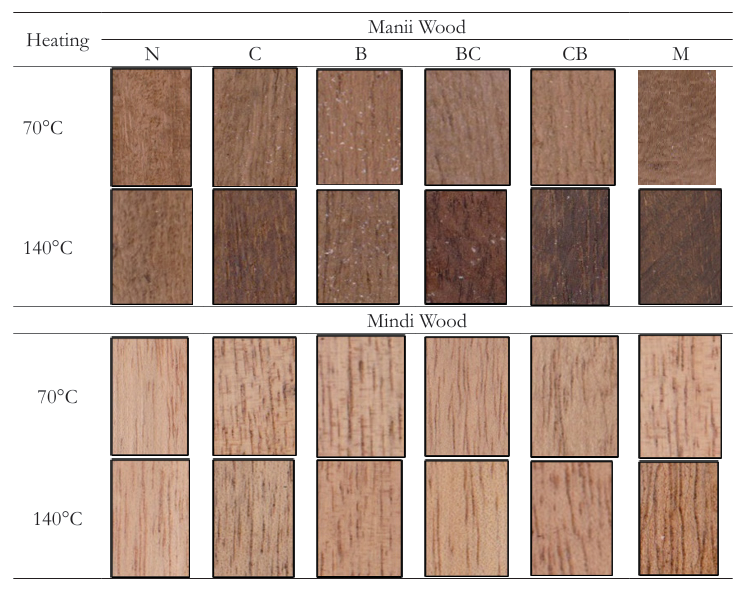
This research aimed to evaluate the effects of boric acid preservative, chitosan, and heat treatments on physical properties, preservative leaching, and weathering resistance of two fast-growing woods. Manii (Maesopsis eminiii Engl.) and mindi (Melia azedarach Linn.) woods were impregnated with 5% boric acid preservative at a pressure of 7 kg cm-2 for 4 hours. The next step involves a second-stage impregnation with chitosan (at a 2% concentration), and mixed combination of boric acid-chitosan, under the same pressure and duration. The final step was heat-treatment at 70 ºC and 140 ºC under atmospheric conditions for 4 hours. The retention of boric acid in manii and mindi woods was 18,1 ± 0,8 kg m-3 and 12,7 ± 0,9 kg m-3, respectively. The interaction of boric acid, chitosan, and heat treatments significantly affected the density, water absorption, leaching, wood dimensional stability, shrinkage, and wood resistance to weathering. Impregnation boric acid-chitosan mixture and heating at 140 ºC (M140) successfully increased the density, ASE, and reduced water absorption and leaching in manii and mindi woods.
Downloads
References
[ASTM] American Society for Testing and Materials. (1976). Standard Test Method of Testing Wood Preservatives by Laboratory Soilblock Cultures. Philadelphia (USA): American Society for Testing and Materials.
[BMKG] Meteorology, Climatology, and Geophysical Agency. (2022) Bogor Regency Daily Climate Report for June-August (in Bahasa Indonesia). Jakarta (ID): Meteorology, Climatology, and Geophysical Agency.
[BS] British Standard. (1957). BS 373-1957: Methods of Testing Small Clear Specimens of Timber by Royal Charter. London (UK): British Standard Institution.
[BSN] Badan Standardisasi Nasional. (1999). Indonesian National Standard Number 01-5010.1 1999. Wood Preservation for Housing and Buildings (in Bahasa Indonesia). Jakarta(ID): National Standardization Agency.
Barcik, S., Gasparik, M., & Razumov, E. (2015). Effect of temperature on the color changes of wood during thermal modification. Cellulose Chemistry and Technology, 49(9): 789-798.
Cahyono, T., D., Lestari, M., D., & Priadi, T. (2022). Mechanical properties of Samama wood (Anthocephallus macrophyllus) after boron and castor bean oil impregnation and heat treatment. International Wood Products Journal, 13(3): 203-208. doi://10.1080/20426445.2022.2084590.
Can, A., & Sivrikaya, H. (2019). Surface characterization of wood treated with boron compounds combined with water repellents. Color Research & Application, 44(3):462–472. doi:// 10.1002/col.22357.
Cao, S., Cai, J., Wu, M., Zhou, N., Huang, Z., Cai, L., & Zhang, Y. (2021). Surface properties of poplar wood after heat treatment, resin impregnation, or both modifications. Bioresources, 16: 7562–7577.
Cho, W., Shields, J.R., Dubrulle, L., Wakeman, K., Bhattarai, A., Zammarano, M., Fox, D.M. (2022) Ion complexed chitosan formulations as effective fire-retardant coatings for wood substrates. Polym. Degrad. Stab. 197: 109870.
Darmawan, W., Nandika, D., Noviyanti, E., Alipraja, I., Lumongga, D., Gardner, D., & Philippe, G. (2017). Wettability and bonding quality of exterior coating on Jabon and Sengon wood surfaces. Journal of Coating Technology and Research, 15: 95-104. doi://10.1007/s11998-017 9954-1.
Demirel, G. K., Temiz, A., Jebrane, M., Terziev, N., & Gezer, E. D. (2018). Micro-distribution, water absorption, and dimensional stability of wood treated with epoxidized plant oils. BioResources, 13(3): 5124–5138. doi://10.15376/biores.13.3.5124-5138.
Fauziyyah, S., Wimmer, R., Halmschlager, E., & Brischike, C. (2023). Unlocking the potential of fast-growing species from Indonesia: durability and sorption aspects. Bois et Forêts des Tropiques, 358: 39-52. doi://10.19182/bft2023.358.a37275.
Fidan, M. S., & Adanur, H. (2019). Physical and mechanical properties of wood impregnated with equebracho and boron compounds. Forestist, 69(1): 68-80. doi://10.26650 /forestist.2019.041645.
Gokhan, G., & Denis, A. (2019). Some physical properties of heat-treated hornbeam (Carpinus betulus L.) wood. Drying Technology, 27(5): 714-720. doi://10.1080/07373930902827700.
Hamii, N., Kędzierska, M., Wrońska, N., Katir, N., Dhainaut, J., Royer, S., Lisowska, K., Bryszewska., Milowska, K., El Kadib, A. (2023). Boron nitride embedded in chitosan hydrogel as a hydrophobic, promising metal-free, sustainable antibacterial material. Material Advances, 21(4): 5191-5199. doi://10.1039/d3ma00445g
Haryanto, A., Hidayat, W., Hasanudin, U., Iryani, D. A., Kim, S., Lee, S., & Yoo, J. (2021). Valorization of Indonesian wood wastes through pyrolysis: a review. Energies, 14(5): 1407. doi://10.3390/en14051407.
Herawati, E., Hartono, R., & Sinaga, H.M. (2021). Physical and mechanical properties of four wood species from community forests in Binjai Regency, North Sumatra. IOP Conf. Series: Earth and Environmental Sciences, 912(1): 1-6. doi://10.1088/1755-1315/912/1/012024.
Hidayat, W., Qi, Y., Jang, J.H, Park, B.H., Banuwa, I.S., Febrianto, F., & Kim, N.H. (2017). Color change and consumer preferences towards color of heat-treated Korean white pine and Royal paulownia woods. Journal of Korean Science Wood Technology, 45(2): 213-222.
Hill, C., Altgen, M., Rautkari L. (2021). Thermal modification of wood-a review: chemical changes and hygroscopicity. Journal Material Science, 56: 6581–6614. https://doi.org/10.1007/s10853–020–05722–z
Istriana, N. (2024). Efektivitas Kombinasi Perlakuan Asam Borat, Kitosan, dan Pemanasan dalam Peningkatan Mutu Kayu Cepat Tumbuh. [Tesis]. Bogor (ID): Institut Pertanian Bogor.
Istriana, N., & Priadi, T. (2021, November). The resistance of modified manii wood with boric acid and chitosan/glycerol and heating against fungi and termites. In IOP Conference Series: Earth and Environmental Science, 891(1): 012010. IOP Publishing. doi://10.1088/1755 1315/891/1/012010.
Kaur, G., Kainth, S., Kumar, R., Sharma, P., Pandey OP. (2021). Reaction kinetics during non- isothermal solid-state synthesis of boron trioxide via boric acid dehydration. Reaction Kinetics, Mechanisme and Catalys, 134:347-359. 10.1007/s11144-021-02084-8
Kim, Y., K., Kwon, G., J., Kim, A., R., Lee, H., S., Purusatama, B., Lee, S., H., Kang, C., W., & Kim N., H. (2018). Effects of heat treatment on the characteristics of royal paulownia (Paulownia tomentosa (Thunb.) Steud.) wood grown in Korea. Journal of the Korean Wood Science and Technology, 46(5): 511-526. doi://10.5658/WOOD.2018.46.5.511.
Kim, Y.S., Kim, J.S., & Lee, K.H. (2016). Weathering characteristics of bamboo (Phyllostachys puberscene) exposed outdoors for one year. Journal of Wood Science, 10 (1): 1007-1086. doi://10.1007/s10086-016-1562-7.
Kol, H., Ş., Keskin, S., A., & Vaydoğan, K., G. (2017). Effect of heat treatment on the mechanical properties and dimensional stability of beech wood. Journal of Advanced Technology Sciences, 6(3): 820-830. doi://10.5658/ WOOD.2018.46.5.511.
Krisdianto, Satiti, E.R., & Supriadi, A. (2018). Discoloration and finishing layer of five wood species due to weathering (in Bahasa Indonesia). Jurnal Penelitian Hasil Hutan, 36(3):205-218.
Lestari, M. D. (2020). Sifat Fisis dan Mekanis Kayu Jabon Merah Termodifikasi Senyawa Boron dan Minyak Jarak Kepyar serta Pemanasan. [Skripsi]. Bogor(ID): Institut Pertanian Bogor.
Muslich, M., & Rulliaty, S. (2016). Resistance of 45 types of Indonesian wood to dry-wood termites and subterranean termites (in Bahasa Indonesia). Jurnal Penelitian Hasil Hutan, 34(1): 51-59.
Nowrouzi, Z., Mohebby, B., & Younesi, H. (2014). Influences of nano-chitosan treatment on physical, mechanical properties, and bio-resistance of wood. Journal Indian Academy Wood Science, 11(2): 174-181.
Oldertroen K, H-Kittikun A, Aam BB, Larnoy E. 2016a. Resistance of rubber wood (Hevea bransiliensis) treated with chitosan or silane against surface molds. European Journal of Wood and Wood Products, 75(1): 101-112. DOI: 10.1007/s00107-016-1071-9.
Papadopoulos, A., Foti, D., & Kyzas, G. (2020). Sorption behavior of water vapor of wood treated by chitosan polymer. European Journal of Wood and Wood Products, 78(3): 483-491. doi://10.1007/s00107-020-01528-7.
Patel, A.K., Michaud, P., Petit, E., de Baynast, H., Gre´diac, M., & Mathias, J.D. (2013). Development of a chitosan-based adhesive application to wood bonding. Journal of Applied Polymer Science, 127: 5014–5021. doi://10.1002/app.38097.
Percin, O., Sofuoglu, S.D., Uzun, O. (2015). Effect on boron impregnation and heat treatment on mechanical properties of oak (Quercus petraea Liebl.) wood. BioResource, 10(3): 3963-3978. doi://10.15376/biores.10(3): 3963-3978.
Priadi T, Kistia J, Khanifah I, Agustin T. 2022. The color changes in and termite and fungal resistance of modified Maesopsis eminii Engl. wood with boric acid and seed oil. Forests, 13(12):1-12. 10.3390/f13121998.
Priadi, T., Sholihah, M., & Karlinasari, L. (2019). Water absorption and dimensional stability of heat-treated fast-growing hardwoods. Jurnal of Korean Wood Science and Technology, 47(5): 567 578. doi://10.5658/WOOD. 2019.47.5.567.
Sadiyo, S., Susanto, D., Pratiwi, N.E.S. (2017). Nilai kekuatan tumpu baut pada empat jenis kayu rakyat Indonesia. Jurnal Teknik Sipil, 24: 153–158.
Suri, I. F., Purusatama, B. D., Lee, S. H., Kim, N. H., Hidayat, W., Ma’ruf, S. D., & Febrianto, F. (2021a). Characteristic features of the oil-heat-treated woods from tropical fast-growing wood species. Wood Research, 66(3): 365–378. doi://10.37763/wr.1336-4561/66.3.365378.
Susdiyanti, T., Meiganati, K. B., Lidiawati, I., & Abiksak, A. (2023). Struktur anatomi dan sifat fisik kayu jati (Tectona grandis L.f.) unggul Nusantara trubusan pada umur 8 tahun. Jurnal Hutan Lestari, 11(1): 28-38.
Syahrial S, Sribudiani E, Somadona S. 2022. Efektivitas pengawetan sengon menggunakan ekstrak biji mahoni dengan metode rendaman dingin terhadap serangan rayap tanah. Journal of Forest Science Avicennia, 5(2):159–167. 10.22219/avicennia.v5i2.21622.
Todaro, L., Rita, A., Negro, F., Moretti, N., Saracino, A., & Zanuttini, R. (2015). Behavior of pubescent oak (Quercus pubescens Willd.) wood to different thermal treatments. Forest Biogeosciences and Forestry, 8: 748–755. doi://10.3832/ifor1348-007.
Turkoglu, T., Baysal, E., Toker, H. (2015). The effect of natural weathering on color stability of impregnated and varnished wood materials. Material Science and Engineering, 2015: 1-9. doi://10.1155/2015/526570.
Vachlepi, A., Suwardin, D., & Hanifarianty, S. (2015). Pengawetan kayu karet menggunakan bahan organik dengan teknik perendaman panas. Jurnal Penelitian Karet, 33(1) :57-64.
Verly, L., D. J., Barnes, H. M., D.S., & Bobadilha, G. (2020). Influence of heat treatment and tannin impregnation on boron depletion and wood durability. Forests, 11(2): 201. doi://10.3390/f11020201.
Vybohova, E., Kucerova, V., Andor, T., Balazova, Z., Velkova, V. (2018). The effect of heat treatment on the chemical composition of ash wood. BioResources, 13(4):8394-8408. DOI: 10.15376/biores.13.4.8394-8408.
Walsh-Korb, Z., Stelzner, I., Dos Santos Gabriel, J., Eggert, G., Avérous, L. (2022). Morphological study of bio-based polymers in the consolidation of waterlogged wooden objects. Materials. 15: 681.
Wei, Y., Wang, M., Zhang, P., Chen, Y., Gao, J., & Fan, Y. (2017). The role of phenolic extractives in color changes of locust wood (Robinia pseudoacacia) during heat treatment. BioResources, 12(4): 7401-7055. doi://10.15376/biores.12.4. 7041-7055.
Winarto, F. (2014). Pengaruh Lama Pengempaan dan Konsentrasi Bahan Perekat Alami Serbuk Cangkang Kepiting Terhadap Sifat Papan Partikel Mahoni. [Skripsi]. Yogyakarta(ID): Universitas Gadjah Mada.
Woźniak, M., Gromadzka, K., Kwaśniewska-Sip, P., Cofta, G., Ratajczak, I. (2022) Chitosan– caffeine formulation as an ecological preservative in wood protection. Wood ScienceTechnology, 56: 1851–1867.
Yang, L., & Liu, H. (2020). Effect of a combination of moderate temperature heat treatment and subsequent wax impregnation on wood hygroscopicity, dimensional stability, and mechanical properties. Forests, 11:1-9. doi://10.3390/f11090920.
Zivonic, S., Davis, R.H., & Golden, D.A. (2015). Chitosan as an antimicrobial in food products. Handbook of Natural Antimicrobials for Food Safety and Quality. Cambridge (UK): Woodhead Publishing.
Downloads
Published
How to Cite
Issue
Section
License
Copyright (c) 2026 Indonesian Journal of Forestry Research

This work is licensed under a Creative Commons Attribution-NonCommercial-ShareAlike 4.0 International License.
All articles published in Indonesian Journal of Forestry Research (IJFR) are licensed under the terms of the Creative Commons Attribution International License (CC BY-NC-SA 4.0) with CC BY-NC-SA 4.0 being the latest version.


 Indonesian Journal of Forestry Research (IJFR) (ISSN Online:


