
MORPHOLOGICAL, ANATOMICAL, AND PHYSIOLOGICAL CHANGES DURING SEED MATURATION OF SUGAR PALM (Arenga pinnata Merr.)
DOI:
https://doi.org/10.59465/ijfr.2026.13.1.109-122Keywords:
Apocol, Embryology, Morphophysiology, Ripening, Sugar palmAbstract
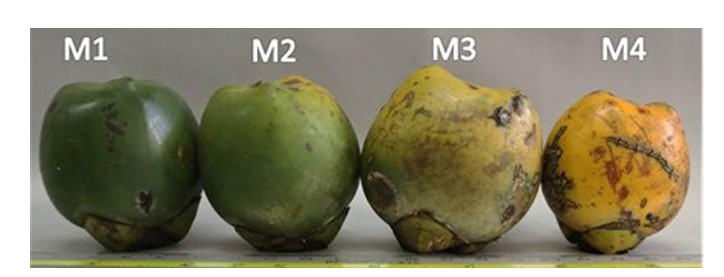
Arenga pinnata (sugar palm) seeds are classified as seeds that have a long dormancy period. This dormancy can be influenced by the maturity level of the sugar palm fruit. This study aims to characterize the morphology and anatomy at various levels of fruit maturity and its relationship to the dormancy of sugar palm seeds. The research was conducted descriptively, involving data collection through morphological, anatomical, and physiological observations of sugar palm fruits and seeds randomly selected from productive sugar palms in Nagari Andaleh Baruh Bukik, Sungayang Subdistrict. The sampling technique was conducted through the purposive sampling method on 12 productive palm trees aged 10 years and above. The results showed that morphologically, there were changes in the color of the skin of the palm fruit to yellowish when it reached physiological maturity, as well as the texture of the hardened seed shell. Changes did not follow these changes in shell color and seed size. Physiologically, there is an increase in gibberellin hormone levels along with the increase in fruit maturity, and it continues to increase when entering the germination phase. Anatomically, the structure of the seed embryo does not show significant changes since the beginning of the fruit ripening. Based on this, there is a mutual relationship between the morphological and physiological characteristics of the dormancy of sugar palm seeds. The riper the palm fruit is, the harder the seed shell is, so the seed dormancy becomes longer and is known as morphophysiological dormancy.
Downloads
References
Aji, I. M. L., & Syaputra, M. (2023). Viability and growth of sugar palm (Arenga pinnata (Wurmb.) Merr.) on various seed maturity levels using natural soaking solutions. Jurnal Multidisiplin Madani, 3(5), 981–993. https://doi.org/10.55927/mudima.v3i5.4105
Al Kausar, R., & Suryani, A. (2022). Penetapan kadar protein kulit pisang kepok (Musa acuminata balbisiana colla) dan kulit pisang tandauk (Musa corniculata) dengan Metode Kjeldahl. Jurnal Analis Farmasi, 7(2), 164–174. https://doi.org/https://doi.org/10.33024/jaf.v7i2.8182
Alsmairat, N., Othman, Y., Ayad, J., Al-Ajlouni, M., Sawwan, J., & El-Assi, N. (2023). Anatomical assessment of skin separation in date palm (Phoenix dactylifera L. var. Mejhoul) fruit during maturation and ripening stages. Agriculture (Switzerland), 13(1), 2 – 11. https://doi.org/10.3390/agriculture13010038
Anwar, A., Sudarsono, & Ilyas, S. (2005). Perbenihan sayuran di Indonesia: Kondisi terkini dan prospek bisnis benih sayuran. Buletin Agronomi, 33, 38–47. https://doi.org/10.24831/jai.v33i1.1513
Anwar, A., Zainal, A., & Armansyah, A. (2018). Micropropagation of male and female trees of andaleh (Morus macroura Miq.) through in-vitro culture using several compositions of basal medium. JERAMI Indonesian Journal of Crop Science, 1(1), 32–38. https://doi.org/10.25077/jijcs.1.1.32-38.2018
Elbar, S., Maytal, Y., David, I., Carmeli-Weissberg, M., Shaya, F., Barnea-Danino, Y., Bustan, A., & Harpaz-Saad, S. (2022). Abscisic acid plays a key role in the regulation of date palm fruit ripening. Frontiers in Plant Science, 13, 1–17. https://doi.org/10.3389/fpls.2022.1066142
Elidar, Y. (2018). Seed emergence and growth of the short age sugar palm (Arenga pinnata) as a response of seed scarification and liquid organic fertilizer application. Asian Journal of Agriculture, 2(1), 8–13. https://doi.org/10.13057/asianjagric/g020102
Gupta, R., & Chakrabarty, S. K. (2013). Gibberellic acid in plant: Still a mystery unresolved. Plant Signaling and Behavior, 8(9), 1 – 5. https://doi.org/10.4161/psb.25504
Hakiki, D. N., & Safitri. (2024). Validasi dan verifikasi pengukuran kadar air gabah menggunakan grain moisture tester dan infrared moisture balance. Gorontalo Agriculture Technology Journal, 7(1), 20–25. https://doi.org/http://dx.doi.org/10.32662/gatj.v0i0.3358
Hamim, Romadlon, Z., & Dorly. (2019). Perkembangan morfo-anatomi bunga, buah, dan biji nyamplung (Calophyllum inophyllum L), sebagai tanaman penghasil biodisel. Jurnal Sumberdaya Hayati, 5, 1 – 10. http://biologi.ipb.ac.id/jurnal/index.php/jsdhayati
Junaedi, A. J., Anwarudin, O., & Makhmudi, M. (2020). Dinamika Kelompok Tani terhadap Minat Generasi Muda pada Kegiatan Usaha Tani Padi (Oryza sativa L.) Di Kecamatan Gantar Kabupaten Indramayu. Jurnal Inovasi Pertanian, 3, 501–512. https://doi.org/https://doi.org/10.47492/jip.v1i3.101
Junaedi, A., Wachjar, A., Yamamoto, Y., & Furqoni, H. (2020). Genotype characterization of sugar palm (Arenga pinnata (Wurmb.) Merr.) on seed and germination stage. IOP Conference Series: Earth and Environmental Science, 418(1), 1–10. https://doi.org/10.1088/1755-1315/418/1/012041
Kapoor, L., Simkin, A. J., George Priya Doss, C., & Siva, R. (2022). Fruit ripening: dynamics and integrated analysis of carotenoids and anthocyanins. BMC Plant Biology, 22(1), 22 – 27. BioMed Central Ltd. https://doi.org/10.1186/s12870-021-03411-w
Lempang, M. (2012). Pohon aren dan manfaat produksinya. Info Teknis EBONI, 9, 37 – 54. https://doi.org/10.20886/buleboni.4993.
Luo, M., Gao, J., Liu, R., Wang, S. Q., & Wang, G. (2023). Morphological and anatomical changes during dormancy break of the seeds of Fritillaria taipaiensis. Plant Signaling and Behavior, 18(1), 1–12. https://doi.org/10.1080/15592324.2023.2194748
Misron, N., Aliteh, N. A., Harun, N. H., Tashiro, K., Sato, T., & Wakiwaka, H. (2017). Relative estimation of water content for flat-type inductive-based oil palm fruit maturity sensor. Sensors (Switzerland),, 17(1), 1–10. https://doi.org/10.3390/s17010052
Natawijaya, D., & Sunarya, Y. (2018). Percepatan pertumbuhan benih aren (Arenga pinnata (Wurmb.) Merr.) melalui perendaman dan pelukaan biji. Jurnal Siliwangi, 4(1), 1–5. https://doi.org/10.37058/jssainstek.v4i1.477.
Nefed’eva, E. E., & Mazey, N. G. (2009). Gibberellin A3 detection in plants with high-performance liquid chromatography. Applied Biochemistry and Microbiology, 45(4), 454–458. https://doi.org/10.1134/S000368380904019X
Ningrum, A. S., Angraini, Z. N., Rahmawati, D., & Masruhim, M. A. (2024). Analisis perbedaan kadar karbohidrat nasi menggunakan Metode Luff Schoorl. Dalton: Jurnal Pendidikan Kimia dan Ilmu Kimia, 7(2), 96. https://doi.org/10.31602/dl.v7i2.14448
Nurhayani, F. O., Wulandari, A. S., & Suharsi, T. K. (2019). Morphology and anatomy of the fruit and seed of Cananga odorata (lam.) hook.f. & Thomson. Biodiversitas, 20(11), 3199–3206. https://doi.org/10.13057/biodiv/d201112
Pangestuti, E. K., & Darmawan, P. (2021). Analisis kadar abu dalam tepung terigu dengan Metode Gravimetri. Jurnal Kimia Dan Rekayasa, 2(1), 16–21. https://doi.org/http://dx.doi.org/10.31001/jkireka.v2i1.22
Pargiyanti. (2019). Optimasi waktu ekstraksi lemak dengan metode soxhlet menggunakan perangkat alat mikro soxhelt, 1(2), 29 – 35. https://doi.org/https://doi.org/10.22146/ijl.v1i2.44745.
Pramono, A. A., & Rustam, E. (2017). Perubahan kondisi fisik, fisiologis, dan biokimia benih Michelia champaca pada berbagai tingkat kemasakan. Prosiding Seminar Nasional Masyarakat Biodiversity Indonesia, 3(3), 368–375. https://doi.org/10.13057/psnmbi/m030313
Rusnam, & Efrizal. (2016). The ability of water plants to reduce the level of mercury pollution in water quality in irrigation. International Journal of Waste Resources, 6(2). https://doi.org/10.4172/2252-5211.1000225
Rusnam, Puari, A. T., Yanti, N. R., & Efrizal. (2022). Utilisation of exhausted coffee husk as low-cost bio-sorbent for adsorption of Pb2+. Tropical Life Sciences Research, 33(3), 229–252. https://doi.org/10.21315/tlsr2022.33.3.12
Saleh, M. S., Adelina, E., Maemunah, Nuraeni, Idham, Samudin, S., & Alam, N. (2007). Perkembangan penelitian teknologi benih aren (Arenga pinnata (Wurmb.) Merr) di Universitas Tadulako. Prosiding Seminar Nasional Hasil Penelitian Fakultas Pertanian Universitas Tadulako, pp 91–95.
Sebayang, L. (2016). Keragaan eksisting tanaman aren (Arenga pinnata Merr.) di Sumatera Utara (Peluang dan potensi pengembangannya). Jurnal Pertanian Tropik, 3(2), 133–138. https://doi.org/https://doi.org/10.32734/JPT.V3I2.2967
Suhendra, D., Ikhsan, Z., & Aisyah, S. (2023). Seed structure and germination pattern of sugar palm (Arenga pinnata L.). IOP Conference Series: Earth and Environmental Science, 1160(1), 1–8. https://doi.org/10.1088/1755-1315/1160/1/012018
Torio, M. Ann. O., Saez, J., & Merca, F. E. (2006). Physicochemical characterization of galactomannan from sugar palm (Arenga saccharifera Labill.) endosperm at different stages of nut maturity. Philippine Journal of Science, 135, 19–30. https://doi.org/10.58794/juragan.v1i1.460
Tresniawati, C., Murniati, E., & Eny, W. (2014). Perubahan fisik, fisiologi dan biokimia selama pemasakan benih dan setudi rekalsitran benih kemiri sunan. Jurnal Agronomi Indonesia, 42(1), 74 – 79. https://doi.org/10.24831/jai.v42i1.8157
Tsabitah, H., Ishmayana, S., & Soedjanaatmadja, U. M. (2024). Isolation, identification and characterization of Gibberellin GA-3 phytohormone from dark septate endophyte (DSE) of sunflower Helianthus annuus. Acta Scientific Nutritional Health, 8(3), 38–50. https://doi.org/10.31080/asnh.2024.08.1356
Vanitha, M., & Vasudevan, S. N. (2019). Effect of fruit maturity stages and post harvest ripening period on seed quality of bitter gourd (Momordica charantia L.). Mysore Journal Agriculture Science, 53(3): 64 – 70. https://www.cabidigitallibrary.org/doi/pdf/10.5555/20193504601.
Viana, F. A. P., Costa, A. P., Moro, F. V., & Pivetta, K. F. L. (2016). Morpho-anatomical characterization of diaspores and seedlings of Livistona rotundifolia. Ornamental Horticulture, 22(3), 249–255. https://doi.org/10.14295/oh.v22i3.924
Widyawati, N., Yudono, P., & Soemardi, I. (2009). Permeabilitas dan perkecambahan benih aren (Arenga pinnata (Wurmb.) Merr.). Jurnal Agronomi Indonesia, 37(2), 1–14. https://doi.org/https://doi.org/10.24831/jai.v37i2.1408
Widyawati, N., Tohari, Yudono, P., & Soemardi, I. (2010). Biokimiawi daya berkecambah benih aren. Agric, 22, 28 – 35.
Wisnubroto, M. P., Putra, E. T. S., & Kurniasih, B. (2020). Tanggapan biokemis, fisiologi, dan agronomis kedelai (Glycine Max L. Merrill) terhadap pemupukan NPK berperekat spent dan doiled bleaching earth (Unpublished master’s thesis). Yogyakarta: Universitas Gadjah Mada.
Wisnubroto, M. P., Putra, E. T. S., & Kurniasih, B. (2021). Effects of spent and deoiled bleaching earth filler-based NPK fertilization on the soil nutrient status and growth of soybean (Glycine max (L.) Merrill). Caraka Tani: Journal of Sustainable Agriculture, 36(2), 213. https://doi.org/10.20961/carakatani.v36i2.43847
Wisnubroto, M. P., Putra, E. T. S., & Kurniasih, B. (2024). Biochemical and agronomic responses of soybean (Glycine max L. Merrill) to spent and deoiled bleaching earth of NPK fertilization on filler basis. Pertanika Journal of Science and Technology, 32(2), 703–723. https://doi.org/10.47836/pjst.32.2.12
Zhang, K., Cao, W., Baskin, J. M., Baskin, C. C., Sun, J., Yao, L., & Tao, J. (2021). Seed development in Paeonia ostii (Paeoniaceae), with particular reference to embryogeny. BMC Plant Biology, 21(1). 1 – 15. https://doi.org/10.1186/s12870-021-03373-z
Downloads
Published
How to Cite
Issue
Section
License
Copyright (c) 2026 Indonesian Journal of Forestry Research

This work is licensed under a Creative Commons Attribution-NonCommercial-ShareAlike 4.0 International License.
All articles published in Indonesian Journal of Forestry Research (IJFR) are licensed under the terms of the Creative Commons Attribution International License (CC BY-NC-SA 4.0) with CC BY-NC-SA 4.0 being the latest version.


 Indonesian Journal of Forestry Research (IJFR) (ISSN Online:


