
STAKEHOLDER ANALYSIS IN PRODUCTION FOREST MANAGEMENT AREAS OF FMU DAMPELAS TINOMBO, CENTRAL SULAWESI
DOI:
https://doi.org/10.59465/ijfr.2026.13.2.231-247Keywords:
FMU Dampelas Tinombo, stakeholder analysis, sustainable forests, benefit distributionAbstract
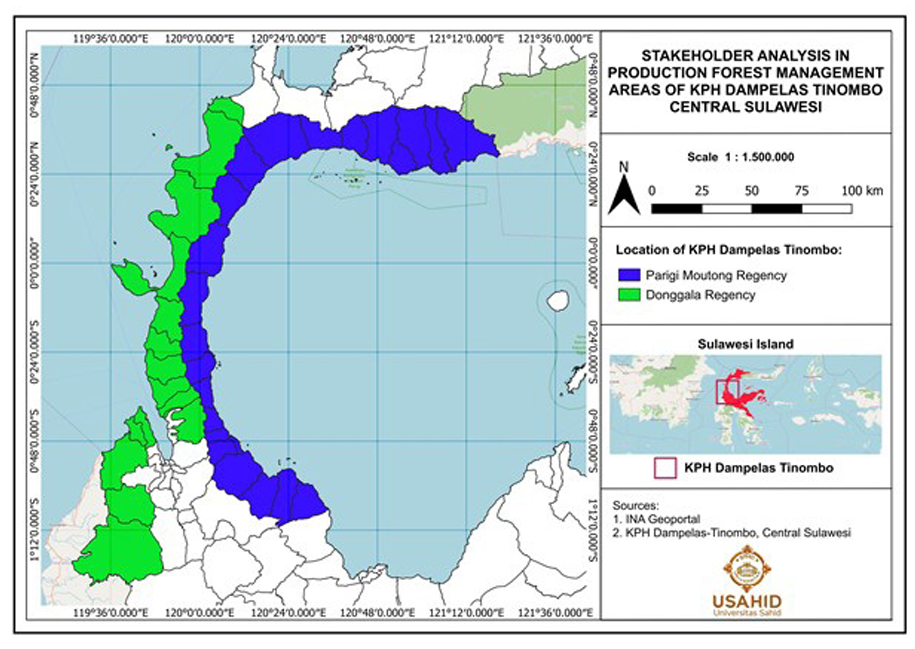
The forest management unit (FMU) of Dampelas Tinombo was the formation of the FMU organization based on the typology of the area in Central Sulawesi. The organization's growth cycle encourages this FMU model as a strategy for institutional formation across stakeholders. This research aimed to identify and describe patterns of power and connectivity between stakeholder actors in the management of production forest areas at FMU Dampelas Tinombo (Unit IV). This research used a qualitative approach with a case study method to understand the interests and influence of stakeholders in managing production forests at the research site. The technique used was a stakeholder analysis matrix involving the categories of Good Relations, Protect, Monitor, and Low Priority, and "3R" (Rights, Responsibilities, and Revenues) analysis. This research revealed an imbalance between rights, responsibilities, and benefits in forest management. Stakeholders with high rights and duties have not received balanced benefits, indicating the problem of unequal distribution of profits. Weak law enforcement and a low public understanding of sustainable forest management were significant obstacles. The policy implications of this research are the need to increase law enforcement, empower communities through education and training regarding sustainable forest management, and review the distribution of rights, responsibilities, and benefits to make them more fair and effective. The findings also provide implications for future research by highlighting the need for comparative and longitudinal studies across different Forest Management Units (FMUs) to evaluate the long-term effectiveness of stakeholder collaboration, institutional governance, and social forestry policies in achieving sustainable forest management.
Downloads
References
Attanasio, G., Preghenella, N., De Toni, A. F., & Battistella, C. (2022). Stakeholder engagement in business models for sustainability: The stakeholder value flow model for sustainable development. Business Strategy and the Environment, 31(3), 860-874. http://dx.doi.org/10.1002/bse.2922
Boiral, O., & Heras-Saizarbitoria, I. (2017). Managing biodiversity through stakeholder involvement: Why, who, and for what initiatives? Journal of Business Ethics, 140(3), 403-421. http://dx.doi.org/10.1007/s10551-015-2668-3
Boutilier, R. (2017). Stakeholder politics: Social capital, sustainable development, and the corporation. New York: Routledge.
Brouwer, H., Hiemstra, W., van Vugt, S., & Walters, H. (2013). Analysing stakeholder power dynamics in multi-stakeholder processes: insights of practice from Africa and Asia. Knowledge Management for Development Journal, 9(3), 11-31.
Colvin, R., Witt, G. B., & Lacey, J. (2020). Power, perspective, and privilege: The challenge of translating stakeholder theory from business management to environmental and natural resource management. Journal of Environmental Management, 271, 110974. http://dx.doi.org/10.1016/j.jenvman.2020.110974
Creswell, J. W., & Creswell, J. D. (2017). Research design: Qualitative, quantitative, and mixed methods approaches. Thousand Oaks, California: Sage Publications.
Daher, B., Hannibal, B., Portney, K. E., & Mohtar, R. H. (2019). Toward creating an environment of cooperation between water, energy, and food stakeholders in San Antonio. Science of The Total Environment, 651, 2913-2926. http://dx.doi.org/10.1016/j.scitotenv.2018.09.395
Fares, J. (2023). A multi-level typology for stakeholder influence: A systematic literature review using the structural approach. European Management Journal, 24. http://dx.doi.org/10.1016/j.emj.2023.08.004
Fisher, Kim, Y.-S., Latifah, S., & Mukarom, M. (2017). Managing forest conflicts: perspectives of Indonesia's forest management unit directors. Forest and Society, 1(1), 8-26. http://dx.doi.org/10.24259/fs.v1i1.772
Fisher, Moeliono, M., Mulyana, A., Yuliani, L., Adriadi, A., Kamaluddin, . . . Sahide, M. A. K. (2018). Assessing the new social forestry project in Indonesia: recognition, livelihood and conservation? International Forestry Review, 20(3), 346-361. http://dx.doi.org/10.1505/146554818824063014
Freeman, R. E. (2023). The politics of stakeholder theory: Some future directions. R. Edward Freeman’s selected works on stakeholder theory and business ethics (pp. 119-132). Springer. https://doi.org/10.1007/978-3-031-04564-6_5
Freeman, R. E., Harrison, J. S., & Zyglidopoulos, S. (2018). Stakeholder theory: Concepts and strategies. Cambridge University Press.
Hariram, N., Mekha, K., Suganthan, V., & Sudhakar, K. (2023). Sustainalism: An integrated socio-economic-environmental model to address sustainable development and sustainability. Sustainability, 15(13), 10682. http://dx.doi.org/10.3390/su151310682
Hutabalian, R. (2023). The part of the production forest management unit to the realizing sustainable forest management at the Sarmi Regency Province of Papua. Bengkoelen Justice: Jurnal Ilmu Hukum, 13(2), 155-171. http://dx.doi.org/10.33369/jbengkoelenjust.v13i2.30877
Kartodihardjo, H., Jaya, I., & Nugroho, B. (2013). Stakeholders analysis of policy-making process: The case of timber legality policy on private forest. Journal of Tropical Forest Management/Jurnal Manajemen Hutan Tropika, 19(2). http://dx.doi.org/10.7226/jtfm.19.2.156
Kazadi, K., Lievens, A., & Mahr, D. (2016). Stakeholder co-creation during the innovation process: Identifying capabilities for knowledge creation among multiple stakeholders. Journal of Business Research, 69(2), 525-540. http://dx.doi.org/10.1016/j.jbusres.2015.05.009
Kim, Y.-S., Bae, J. S., Fisher, L. A., Latifah, S., Afifi, M., Lee, S. M., & Kim, I.-A. (2016). Indonesia's forest management units: effective intermediaries in REDD+ implementation? Forest Policy and Economics, 62, 69-77. http://dx.doi.org/10.1016/j.forpol.2015.09.004
Kusmana, C., & Sukwika, T. (2018). Coastal community preference on the utilization of mangrove ecosystem and channelbar in Indramayu, Indonesia. AACL Bioflux, 11(3), 905-918. http://www.bioflux.com.ro/home/volume-11-3-2018/
Mahajan, R., Lim, W. M., Sareen, M., Kumar, S., & Panwar, R. (2023). Stakeholder theory. Journal of Business Research, 166, 114104. http://dx.doi.org/10.1016/j.jbusres.2023.114104
Mato-Santiso, V., Rey-García, M., & Sanzo-Pérez, M. J. (2021). Managing multi-stakeholder relationships in nonprofit organizations through multiple channels: A systematic review and research agenda for enhancing stakeholder relationship marketing. Public Relations Review, 47(4), 102074. http://dx.doi.org/10.1016/j.pubrev.2021.102074
McComb, E. J., Boyd, S., & Boluk, K. (2017). Stakeholder collaboration: A means to the success of rural tourism destinations? A critical evaluation of the existence of stakeholder collaboration within the Mournes, Northern Ireland. Tourism and Hospitality Research, 17(3), 286-297. http://dx.doi.org/10.1177/1467358415583738
McGlone, M. S., McNutt, K., Richardson, S. J., Bellingham, P. J., & Wright, E. F. (2020). Biodiversity monitoring, ecological integrity, and the design of the New Zealand Biodiversity Assessment Framework. New Zealand Journal of Ecology, 44(2), 1-12.
Meyer, S. R., Johnson, M. L., Lilieholm, R. J., & Cronan, C. S. (2014). Development of a stakeholder-driven spatial modeling framework for strategic landscape planning using Bayesian networks across two urban-rural gradients in Maine, USA. Ecological Modelling, 291, 42-57. http://dx.doi.org/10.1016/j.ecolmodel.2014.06.023
Reed, M. S., Vella, S., Challies, E., De Vente, J., Frewer, L., Hohenwallner‐Ries, D., . . . Sidoli del Ceno, J. (2018). A theory of participation: what makes stakeholder and public engagement in environmental management work? Restoration Ecology, 26, S7-S17. http://dx.doi.org/10.1111/rec.12541
Sahraoui, Y., Leski, C. D. G., Benot, M.-L., Revers, F., Salles, D., van Halder, I., . . . Carassou, L. (2021). Integrating ecological networks modelling in a participatory approach for assessing impacts of planning scenarios on landscape connectivity. Landscape and Urban Planning, 209, 104039. http://dx.doi.org/10.1016/j.landurbplan.2021.104039
Sugiyono. (2017). Quantitative, qualitative and R&D research methods. Bandung Alfabeta.
Sukwika, T. (2018). Actor analysis in formulating institutional models for community-forest development in Bogor Regency. Journal of Regional and Rural Development Planning, 2(2), 133-150. http://dx.doi.org/10.29244/jp2wd.2018.2.2.133-150
Sukwika, T., Darusman, D., Kusmana, C., & Nurrochmat, D. R. (2016). Evaluating the level of sustainability of privately managed forest in Bogor, Indonesia. Biodiversitas, Journal of Biological Diversity, 17(1), 241-248. http://dx.doi.org/10.13057/biodiv/d170135
Sukwika, T., Darusman, D., Kusmana, C., & Nurrochmat, D. R. (2018). Policy scenarios for managing of sustainability private-forests in Bogor Regency. Journal of Natural Resources and Environmental Management, 8(2), 207-215. http://dx.doi.org/10.29244/jpsl.8.2.207-215
Sukwika, T., & Fransisca, L. (2021). The policy model for sustainable community forest: A factor analysis. Indonesian Journal of Forestry Research, 8(2), 135-157. http://dx.doi.org/10.20886/ijfr.2021.8.2.135-157
Tian, F., Li, M., Han, X., Liu, H., & Mo, B. (2020). A production–living–ecological space model for land-use optimisation: A case study of the core Tumen River region in China. Ecological Modelling, 437, 109310. http://dx.doi.org/10.1016/j.ecolmodel.2020.109310
Yin, R. K. (2018). Case study research and applications: Design and Methods (6th ed.) CA: Sage Thousand Oaks.
Zubayr, M., Darusman, D., Nugroho, B., & Nurrochmat, D. R. (2014). The roles of stakeholders in policy implementation of the use of forest area for mining activity. Jurnal Analisis Kebijakan Kehutanan, 11(3), 239-259. http://dx.doi.org/10.20886/jakk.2014.11.3.239-259
Downloads
Published
How to Cite
Issue
Section
License
Copyright (c) 2026 Indonesian Journal of Forestry Research

This work is licensed under a Creative Commons Attribution-NonCommercial-ShareAlike 4.0 International License.
All articles published in Indonesian Journal of Forestry Research (IJFR) are licensed under the terms of the Creative Commons Attribution International License (CC BY-NC-SA 4.0) with CC BY-NC-SA 4.0 being the latest version.


 Indonesian Journal of Forestry Research (IJFR) (ISSN Online:


